
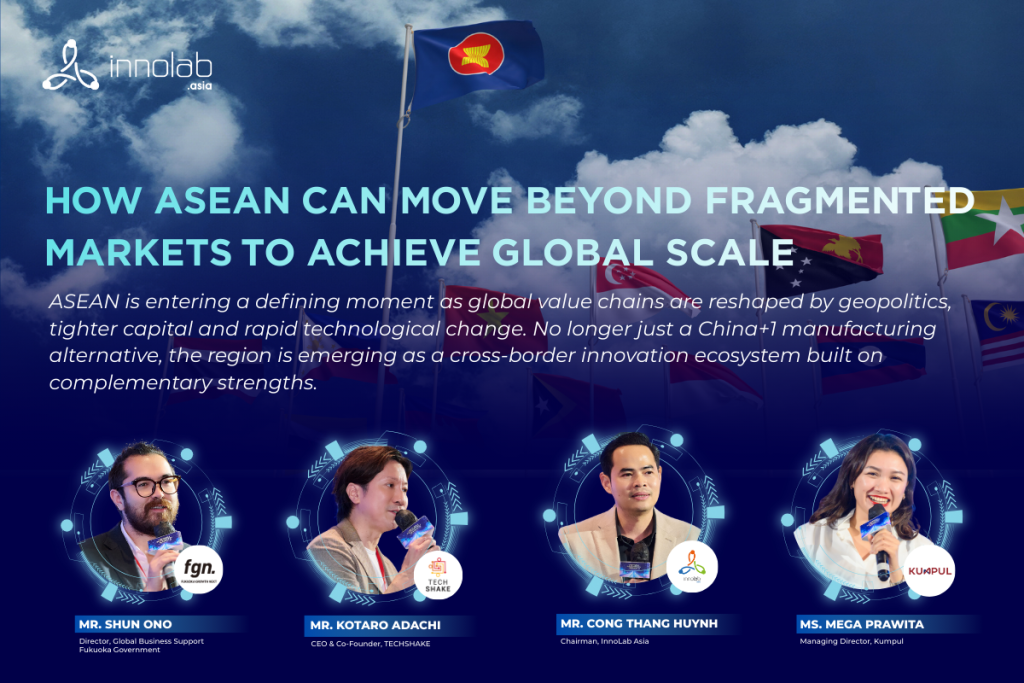
As global value chains undergo profound restructuring amid geopolitical tensions, cautious capital flows, and rapid technological change, ASEAN is approaching a defining moment. No longer seen merely as an alternative manufacturing destination in the China+1 strategy, the region is increasingly positioning itself as a cross-border innovation ecosystem—one in which countries complement rather than compete with one another to build global competitiveness.

This transformation was at the heart of the panel discussion “Cross-Border Innovation – From ASEAN Hub to Global Scale” at the Vietnam Innovation Summit 2025. The central question raised was no longer whether ASEAN can grow, but whether it can move beyond fragmented national markets to function as a unified bloc—large, deep and credible enough for startups and enterprises to scale internationally.
The consensus was clear. The answer does not lie in the success of any single country, but in ASEAN’s ability to connect its strengths, assign complementary roles and operate as a unified ecosystem rather than as isolated markets competing for attention.
ASEAN at the Inflection Point of Cross-Border Innovation
Global venture capital has entered a more cautious phase, reflecting broader uncertainty in the world economy. However, as Ms. Mega Prawita, Managing Director of Kumpul, observed during the discussion, slower investment cycles may actually offer a strategic window of opportunity. When capital becomes more selective, she noted, it creates space for ecosystems to focus less on rapid expansion and more on building durable foundations for cross-border cooperation.

In fact, ASEAN possesses a rare advantage because its member states contribute different strengths to the innovation value chain
- Vietnam: high-quality technology workforce, competitive costs
- Indonesia: huge domestic market, fast-paced consumption
- Philippines: English language advantage and digital services
- Singapore: global capital, finance, and connectivity hub
The discussion emphasized that the strategic question is not which country should lead, but how these strengths can be integrated into a coherent regional capability. When ASEAN operates as a system rather than as separate markets, its collective value becomes far greater than the sum of its parts.
Scaling globally requires reframing ASEAN as a single market
One of the persistent barriers faced by startups in Southeast Asia is the perception of limited market size when individual countries are viewed in isolation. Mr. Kotaro Adachi, CEO and Co-Founder of TECHSHAKE, highlighted how this perception can quickly change when ASEAN is framed as a single regional opportunity.
From an investor’s perspective, markets such as the Philippines may appear modest on their own. However, when aggregated at the ASEAN level, the region rivals major economies like Japan in scale and strategic relevance. This reframing shifts investor attention from local constraints to regional growth potential.

However, panelists stressed that such reframing must be backed by operational reality. Startups seeking to scale regionally must demonstrate the ability to enter multiple markets, adapt to different regulatory environments and replicate business models across borders. Crucially, this often cannot be achieved alone. Cross-border alliances and platforms, such as Atlas Alliance, are emerging to enable shared access to resources, networks and markets, transforming regional diversity into a competitive advantage rather than a barrier.
Trust and connectivity are the foundations of global expansion
Beyond capital and technology, the discussion repeatedly underscored trust as a defining factor in Asia’s innovation landscape. Mr. Cong Thang Huynh, Chairman of InnoLab Asia, emphasized that relationships and credibility form the invisible infrastructure of cross-border cooperation. In Asia, he noted “ Asia operates on relationships and trust. Cooperation takes time to prove its capabilities; shortcuts are not an option.”
ASEAN’s dynamic of cooperation and competition makes this especially critical. While countries compete for investment and talent, they also rely on one another to strengthen the region’s overall position. When grounded in shared standards and mutual trust, this balance can enhance resilience rather than create friction. As panelists cautioned, meaningful ecosystem alliances must move beyond symbolic partnerships and be anchored in real projects, real markets and tangible outcomes.

At the same time, achieving global scale requires bridges beyond the region. Mr. Shun Ono, Director of Global Business Support at the Fukuoka Government, pointed to emerging regions such as the Middle East and Central Asia as high-growth opportunities. He highlighted the growing role of cities as agile connectors, noting how cities like Fukuoka actively link Japan and ASEAN through startup incubation, support programs and market access. This form of city-level innovation diplomacy is becoming an increasingly effective pathway for cross-border expansion.

Conclusion
ASEAN is entering a new phase of globalization, more fragmented but also more open to countries capable of building cross-border linkages. Cross-border innovation not only offers the region a way to adapt to global instability, but also an opportunity to shape emerging economic structures, rather than simply reacting to them.
For Vietnam, the message from the conference is clear. The path to global reach no longer goes solely through national markets. It goes through ASEAN – and through the collective strength that comes from moving forward together, rather than alone.