
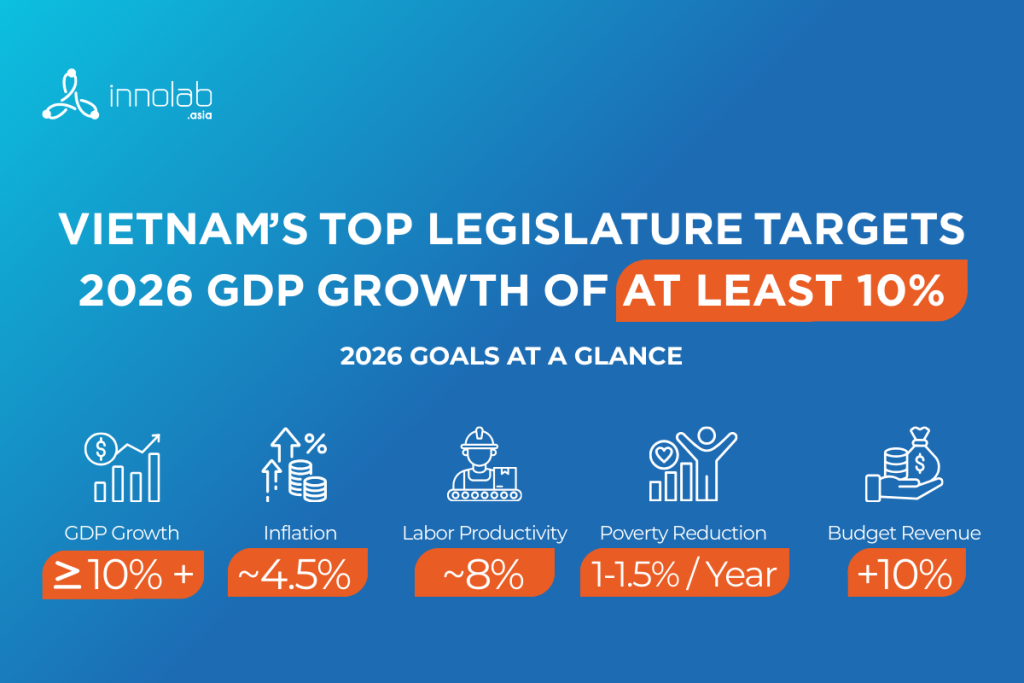
Vietnam’s government has laid out an ambitious draft plan for 2026, targeting 10% GDP growth and raising per capita income to between $5,400–5,500, with inflation projected at around 4.5%. Budget revenue is expected to rise by 10%, while regular spending and public investment will be trimmed to prioritize key infrastructure projects like the Lao Cai – Ha Noi – Hai Phong railway. The strategy also emphasizes restructuring the credit system, resolving bad debt, and accelerating growth in digital, green, and high-tech sectors such as AI and semiconductors. Therefore, there is a question, What is the strategic role of SMEs and startups in helping Vietnam achieve its 10% GDP growth target?

Major objectives set for 2026
The Government will keep the average consumer price index (CPI) growth rate at about 4.5 percent, the average social labor productivity growth at around 8 percent while reducing the multidimensional poverty rate by approximately 1–1.5 percent per year, said Mr. Pham.
Mr.Pham Minh Chinh emphasized that the overarching goal for 2026 is to promote growth, maintain macroeconomic stability, control inflation, and ensure major economic balances. At the same time, Viet Nam will focus on enhancing strategic autonomy, restructuring the economy, innovating its development model, and accelerating industrialization, modernization, and urbanization.
Speaking at the Vietnam Innovation Summit 2025, Ms. Alexandra Smith, British Consul General and Director for Trade at the British Consulate General in HCMC, emphasized that Vietnam’s decision to establish an International Finance Centre (IFC) in Ho Chi Minh City and Da Nang is a strategic and foundational step for a new phase of development. According to her, the IFC is not just a financial project, but an integrated ecosystem encompassing infrastructure, legal framework, and human resources, serving as a springboard for innovation, digital growth, and attracting long-term global capital flows.
The larger goal is to lay the groundwork for Vietnam to move closer to high-income status by 2045, while positioning itself as a reliable financial and innovation destination in the regionFrom the perspective of international investors, she also agreed that 2026 marks the point where Vietnam needs to shift from “rapid growth” to “quality growth,” in which the role of private capital, especially private and venture capital, becomes crucial. Vietnam aims not only to expand the scale of the digital economy and innovation, but also to build a standardized ecosystem where innovation becomes “investable,” rather than just remaining potential.

Speaking at VIS, Mr. Cong Thang Huynh – Chairman of InnoLab Asia – argued that Vietnam’s high growth target in the coming period cannot be achieved if businesses only develop in isolation within a single country. According to him, Asia – especially ASEAN – operates based on relationships and trust, and building cross-border innovation alliances is a prerequisite for Vietnamese SMEs and startups to expand their market reach. When Vietnamese businesses participate in regional networks, their access to projects, customers, and capital will increase significantly, thereby contributing more directly to GDP growth instead of just focusing on the domestic market.

How can we better harness the purchasing power of the domestic market and transform domestic consumption into a genuine growth engine?
For domestic consumption to truly contribute to the 10% GDP growth target, the focus should not only be on short-term demand stimulation, but also on enhancing the capacity of domestic businesses – especially SMEs and startups – to create products and services with higher added value.
At VIS, Mr. Xu Zhou, Deputy Consul General Consulate, General of the People’s Republic of China in Ho Chi Minh City, emphasized that in China’s development model, domestic consumption only truly breaks through when it is closely linked to infrastructure, technology, and large-scale markets. According to him, the digital economy now accounts for over 40% of China’s GDP, thanks to domestic businesses effectively utilizing technology to expand markets and optimize costs.
The lesson for Vietnamese SMEs and startups is: harnessing domestic purchasing power is inseparable from digital transformation and business model innovation. E-commerce platforms, fintech, digital logistics, and AI-powered personalized customer experiences allow businesses to access broader markets at lower costs – thereby sustainably expanding consumption, rather than relying on short-term promotions or subsidies.

In addition, the trend towards green and socially responsible consumption is becoming increasingly evident, especially among young middle-class consumers. This opens up significant opportunities for startups in the fields of recycled products, low-carbon consumption, clean energy, and emissions measurement technology.
According to Ms. Alexandra Smith – Consul General and Director of Trade of the UK in Ho Chi Minh City, global corporations are now not only concerned with price, but also demand transparency regarding carbon footprint and ESG throughout the entire value chain. This not only puts pressure on FDI, but also presents an opportunity for Vietnamese SMEs to participate more deeply in new supply chains if they develop the capacity to measure, report, and optimize emissions early on.
What role do SMEs and startups play in achieving a 10% GDP growth target?
According to Mr. Jasper Hilkhuijsen, Senior East Asia Innovation & Sustainable Development Manager, Arup, today’s investors evaluate a country not only by labor costs, but also by the quality of its digital infrastructure, clean energy, and smart operational capabilities. This means that Vietnamese SMEs and startups are not just “satellites,” but can become providers of technology, logistics, energy, and data solutions for both the domestic and FDI markets.

Meanwhile, speakers on cross-border innovation such as Mega Prawita (Kumpul) and Kotaro Adachi (TECHSHAKE) emphasized that the current period is ideal for Vietnamese startups to scale with ASEAN, viewing the region as a unified market rather than individual countries. As Vietnamese businesses expand regionally, their contribution to GDP will come not only from domestic consumption, but also from the export of services, technology, and business models.
Vietnam’s target of 10% GDP growth is ambitious, but not unattainable if SMEs and startups are placed at the center of the growth strategy.
This should not be measured by the number of businesses, but by the quality of innovation, scalability, and participation in new value chains.