
At the panel discussion “AI, Data & Digital Business Models – Pathway to Vietnam’s $200B Digital Growth” at the Vietnam Innovation Summit 2025, experts agreed that this is a golden moment for Vietnamese enterprises to accelerate and take strategic actions to turn on-paper aspirations into reality.
According to the e-Conomy SEA report published by Google, Temasek, and Bain & Company, Vietnam is among the fastest-growing digital economies in Southeast Asia. Vietnam’s total gross merchandise value (GMV) for digital goods and services reached USD 36 billion in 2024 and is forecasted to reach USD 200 billion by 2030, equivalent to a compound annual growth rate (CAGR) of over 30%. As Vietnam’s digital economy enters this critical phase of development, a significant paradox is emerging: businesses have needs, the market has potential, and policies provide momentum, however the execution speed has not kept up with expectations.

The panel discussion “AI, Data & Digital Business Models – Pathway to Vietnam’s $200B Digital Growth” took place on the afternoon of November 6th.
Challenges for Vietnamese businesses in applying AI
Despite their immense potential, most Vietnamese businesses are lagging behind in AI adoption due to a mindset of “waiting for perfection, talent or infrastructure.” As Mr. Anirban Roy – Senior Partner at InnoLab Asia has shared, AI is shifting from a trend to essential infrastructure and hesitation only increases opportunity costs by the day. A narrow approach that focuses solely on the domestic market also prevents startups from scaling and limits their growth potential.
Meanwhile, AI human resources remain a major barrier. Universities focus heavily on theory, while businesses require hands-on implementation capabilities. Many companies focus only on hiring IT professionals rather than improving AI, Data literacy across the entire workforce. This gap between demand and capability is hindering SMEs from accelerating their growth, especially as new AI-based business models are expected to surge in the coming years.
According to research by Google, Temasek, Bain & Company, AI demand in Southeast Asia is in a “demand pull” phase: enterprise AI is growing 25–30% annually, while internal automation demand in Vietnam has increased by up to 40% since 2023. The biggest competitive advantage lies in the fact that AI is enabling SMEs and startups to leapfrog resource limitations. Vietnamese enterprises can fully:
- Shorten time to market by 50–70% with AI-powered market analysis systems.
- Increase revenue by 20–30% through large-scale customer experience personalization.
- Create new business models capable of regional expansion instead of serving only the domestic market.
Fintech models such as embedded lending, AI-driven alternative credit scoring, and personalized digital commerce are forecasted to account for 10–15% of the region’s digital transaction value by 2030. In addition, Vietnam is expanding submarine cable networks, accelerating cloud-first policies, and promoting regulatory sandboxes for fintech. This means AI deployment costs are decreasing, while access to computing resources is expanding a rare opportunity in the technology development cycle.
If Vietnamese startups do not enter the game today, the market will quickly be dominated by foreign platforms that already possess advantages in technology, speed, and capital.
The Solution to Unlock the 200-Billion-Dollar Opportunity: Start with an “AI-First and Region-Expansion” Mindset
In this context, experts at VIS 2025 proposed a practical yet ambitious roadmap. First, SMEs and startups should not wait for “absolute readiness” to adopt AI. AI co-pilots, internal automation systems, and data analytics models can immediately deliver productivity gains. With proper application, businesses can reduce up to 70% of manual tasks, freeing resources to focus on innovation.
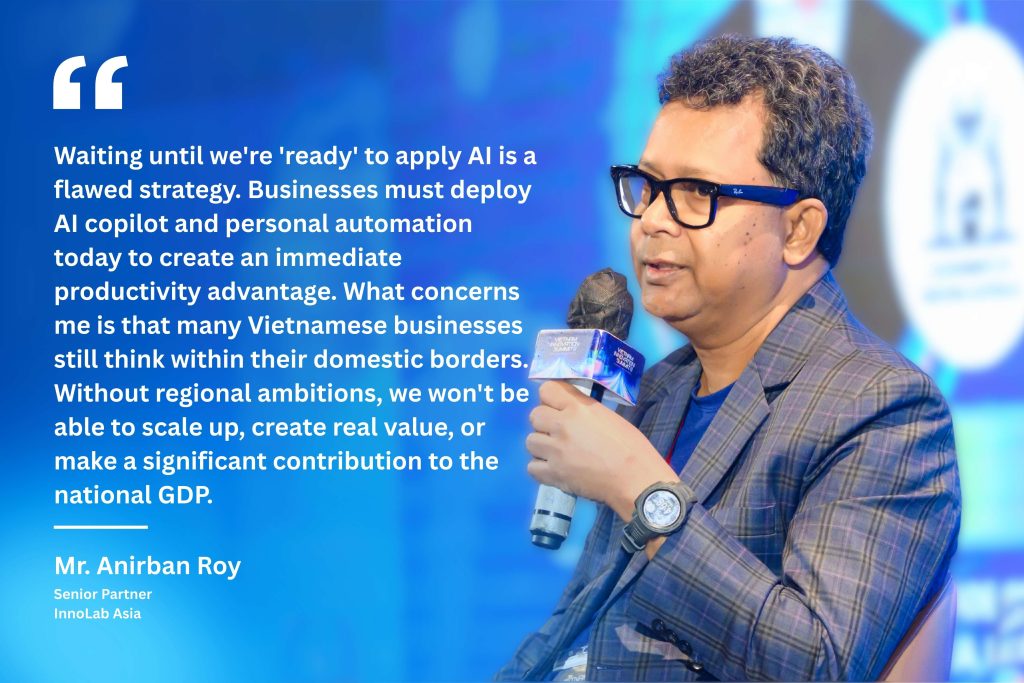
Mr. Anirban Roy – Senior Partner,InnoLab Asia shared at VIS 2025
Additionally, market thinking must expand beyond Vietnam. As Mr. Anirban Roy emphasized, only when enterprises aim for 10–20 times growth through regional expansion can they truly create value and own strong enough IP to contribute meaningfully to the digital economy.
Mr. Vuong Quan Ngoc – Chief Sales Officer & Partner at FPT Digital Digital proposed a strategic development framework based on Capability, Connectivity, and Collaboration. Capability here refers not merely to human resources, but to the ability to own core technologies in AI, data, and cloud. Connectivity refers to building digital trust among the government, enterprises, and citizens. Collaboration requires high-quality FDI, large venture capital funds, and sandbox models for fintech that allow businesses to experiment safely.

Mr. Vuong Quan Ngoc – Director of Business & Partnerships, FPT Digital, shared at VIS 2025.
From a national digital infrastructure perspective, Mr. Nils Michaelis – Managing Director at Thoughtworks emphasized a new PPP model based on Pipes – Policy – People. Vietnam needs more submarine cable infrastructure, more open policies for data and cloud, and a truly abundant AI talent ecosystem. When AI is integrated into logistics, smart manufacturing, predictive maintenance, and more, Vietnam’s competitiveness on the global production map will significantly increase.
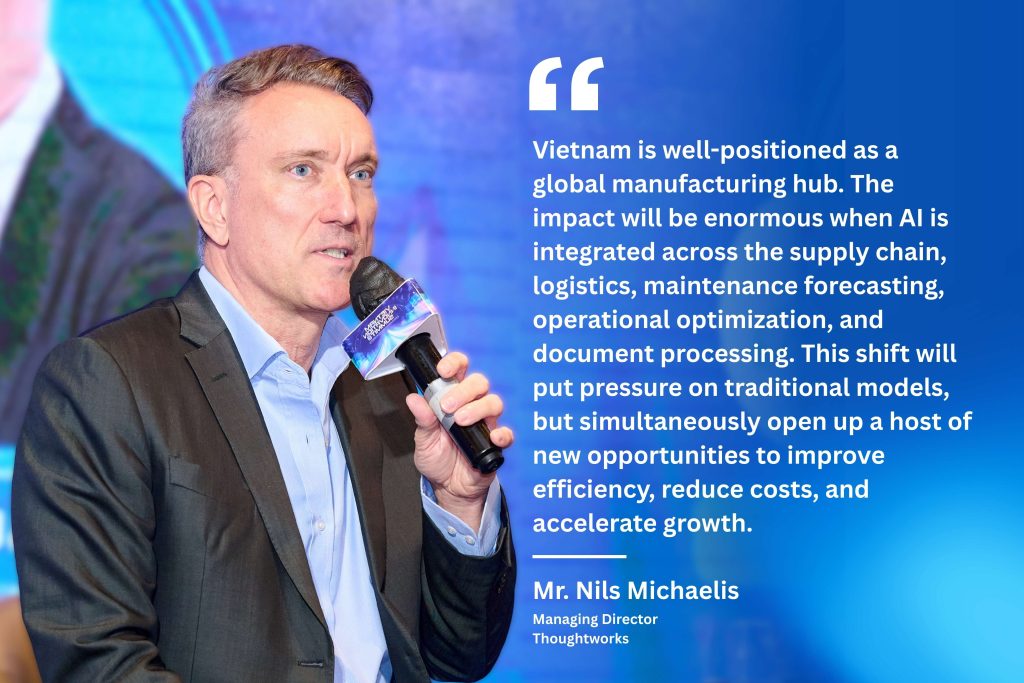
Nils Michaelis – Managing Director, Thoughtworks shared at VIS 2025.
The government is also urged to expand sandbox mechanisms, build reliable data oracles, and maintain cloud-first policies to create a strong foundation for digital enterprises to accelerate. Investment must shift toward high-quality FDI and large funds that support foundational innovation instead of small-scale services.
As the digital market advances at unprecedented speed, the choice for SMEs and startups is clear: be proactive, or be left behind. The combination of AI, data, infrastructure, policy, and capital will determine which enterprises are ready to step into the next growth cycle. Vietnam’s 200-billion-dollar digital economy target is no longer a distant vision, it is a race in which those who transform earliest will be the ones who win.