

In the era of the knowledge economy, national prosperity is no longer determined solely by natural resources or production scale. It increasingly depends on a country’s ability to transform knowledge into tangible economic value. Innovation has therefore become a decisive pillar of competitiveness in a globalized economy.
On the global innovation map, Vietnam is no longer merely an emerging name marked by steady improvements in both capability and performance. The country is progressively positioning itself toward a more strategic role within the international innovation ecosystem.
1. Vietnam as an “innovation overperformer”.
One of the most notable indicators of Vietnam’s trajectory is its ranking in the Global Innovation Index (GII) 2025, published by the World Intellectual Property Organization (WIPO). Vietnam ranks 44th out of 139 economies worldwide, maintaining a strong position among lower-middle-income countries.
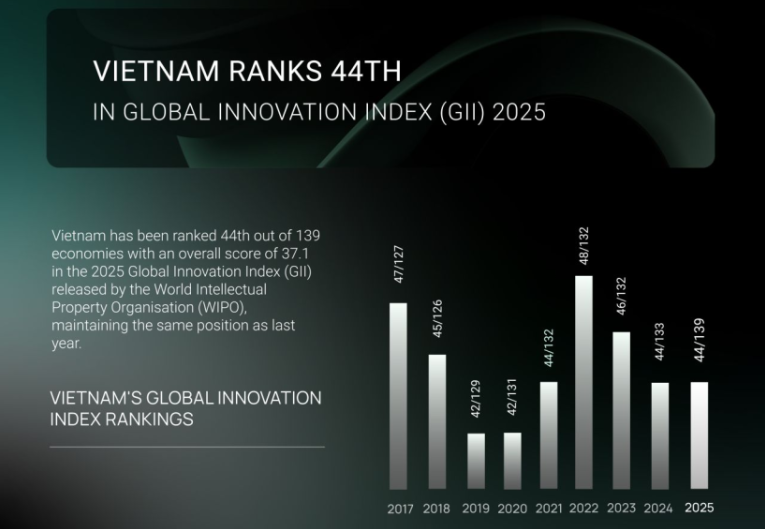
Within the group of 37 lower-middle-income economies, Vietnam ranks second, behind only India, outperforming many countries with comparable economic scales.
Notably:
✔ Vietnam has been recognized as an “Innovation Overperformer” for 15 consecutive years, meaning its innovation performance exceeds expectations relative to its income level.
✔ The country’s innovation input index improved by three positions compared to the previous year, reflecting progress in institutions, infrastructure, and innovation-related resources.
✔ Its innovation output index remains within the global top 40, demonstrating the ability to convert inputs into measurable results.
These indicators suggest that Vietnam is not merely participating in the global innovation system; it is increasingly optimizing the transformation of innovation into long-term competitive advantage.
2. Internal Transformation: From Manufacturing to Innovation Capabilities
A defining characteristic of Vietnam’s innovation journey is its structural transition from pure manufacturing to a more diversified capability network.
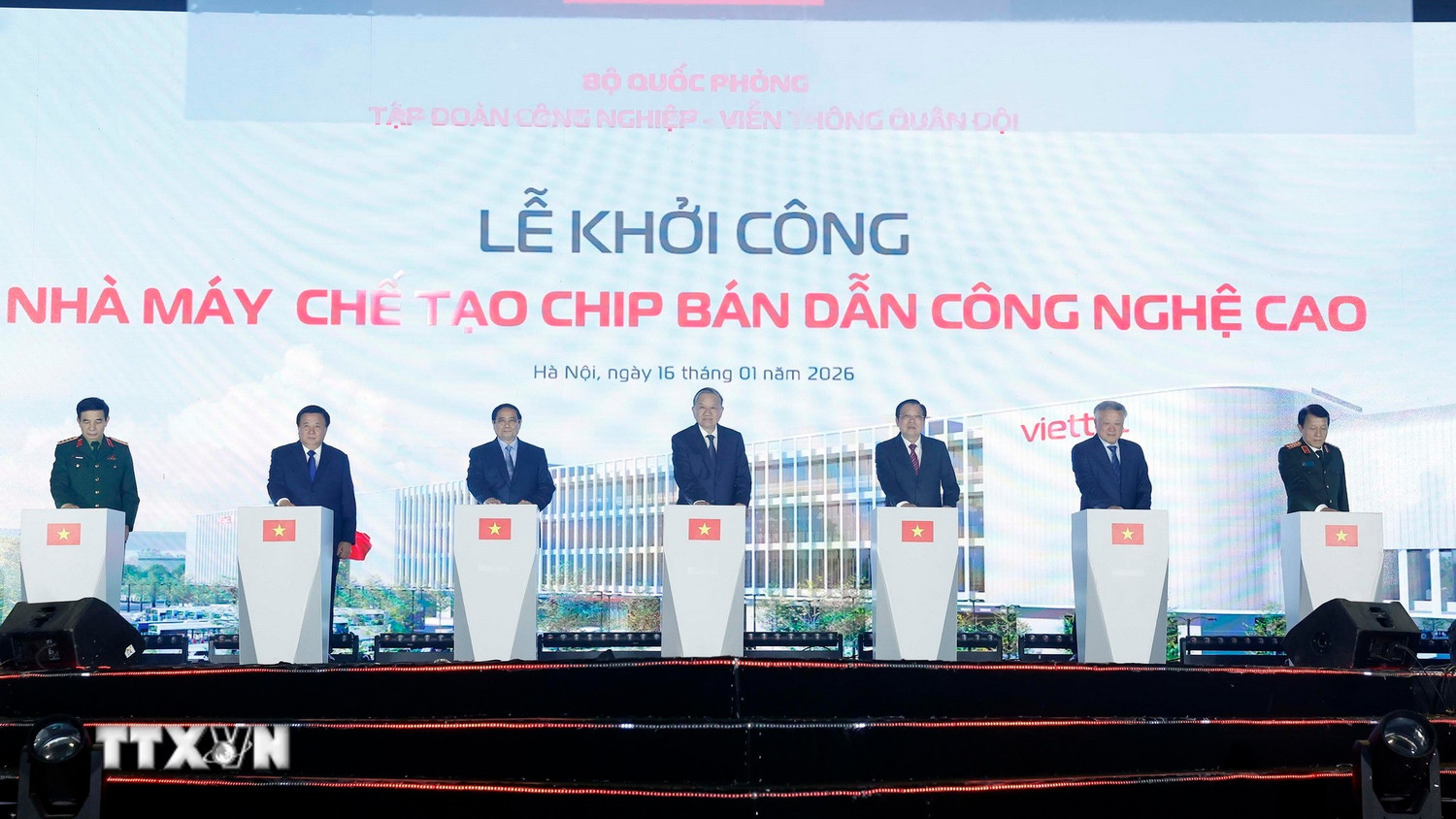
Rather than relying solely on traditional industries, the Vietnamese economy has:
- Rapidly expanded exports in information technology, electronics, and telecommunications equipment, while maintaining stability in agriculture and increasingly technology-enabled textile sectors.
- Developed production capabilities across multiple levels, from labour-intensive operations to higher value-added stages within global supply chains.
This transition reflects a shift from “assembly-based manufacturing” to “value chain integration”, strengthening the country’s capacity to absorb, operate, and incrementally improve technologies through real production experience.
Such evolution enables both enterprises and the broader economy not only to remain competitive in the short term but also to establish a foundation for upgrading innovation capabilities in the medium and long term.
3. Advantage Through Capability Networks and Global Integration
The report emphasizes that the most successful economies are those that balance expansion with depth, developing new capabilities while strengthening core ones. Vietnam is among the few economies in Asia demonstrating this dual-track pattern.
Specifically:
- Vietnam has continuously increased the complexity of its capability portfolio by integrating manufacturing, technology, and trade.
- Participation in global capability networks allows domestic enterprises to access international standards and learn from advanced innovation hubs.
At a time when nearly half of the world’s economies have not significantly diversified their innovation capabilities, Vietnam’s ability to expand across multiple dimensions simultaneously represents a clear strategic advantage.
4. Accelerated Growth in Brand and Intangible Assets
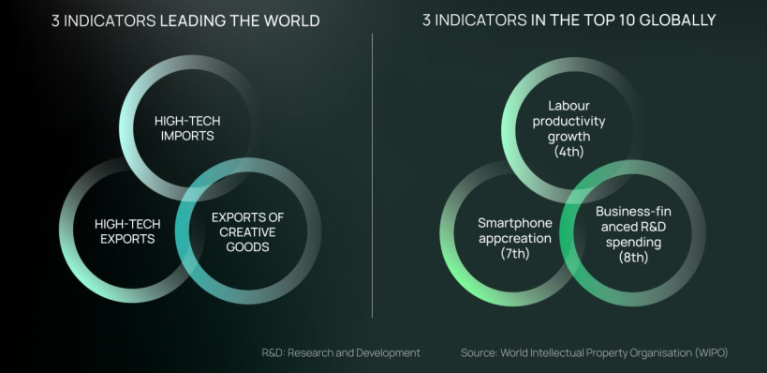
Another positive development is the growing emphasis on brand value and intangible assets, critical factors that create sustainable competitive advantage and long-term market protection.
Vietnamese enterprises are increasingly:
- Filing international trademark registrations,
- Expanding intellectual property protection,
Increasing exports of creative services and knowledge-intensive products.
These developments reflect a rising awareness of the strategic value of intangible assets and contribute to strengthening brand positioning within global value chains.
5. Where Does Vietnam Stand on the Global Innovation Map?
Despite substantial progress, Vietnam’s current position also reveals existing gaps:
- The country still trails leading innovation economies in large-scale breakthrough research and deep R&D intensity.
- However, ranking 44th out of 139 economies in GII 2025 places Vietnam in a strategic position among developing nations, with significant potential for upward mobility if it continues to strengthen endogenous innovation capabilities and deepen global integration.
Vietnam has set ambitious targets: entering the global Top 40 by 2030, and aiming for Top 30 within the next 10–15 years. These goals signal a long-term strategic commitment to innovation-driven development.
Strategic Implications for Vietnamese Enterprises
For businesses, these figures are not merely rankings; they represent validation of national competitiveness and signal important strategic implications:
- Innovation is no longer optional; it is an essential component of corporate strategy.
Investment in brand, intangible assets, and market connectivity offers more sustainable advantages than competing primarily on labour cost. - Vietnamese enterprises can leverage the country’s growing production–technology base to move into more complex, higher-value sectors without starting from zero.
Vietnam is not simply “present” on the global innovation map. It is actively redefining its position as a dynamic, connected, and consistently overperforming economy. With its current trajectory, Vietnam holds the potential to inspire enterprises, institutions, and policymakers alike in co-creating a resilient and forward-looking knowledge economy.